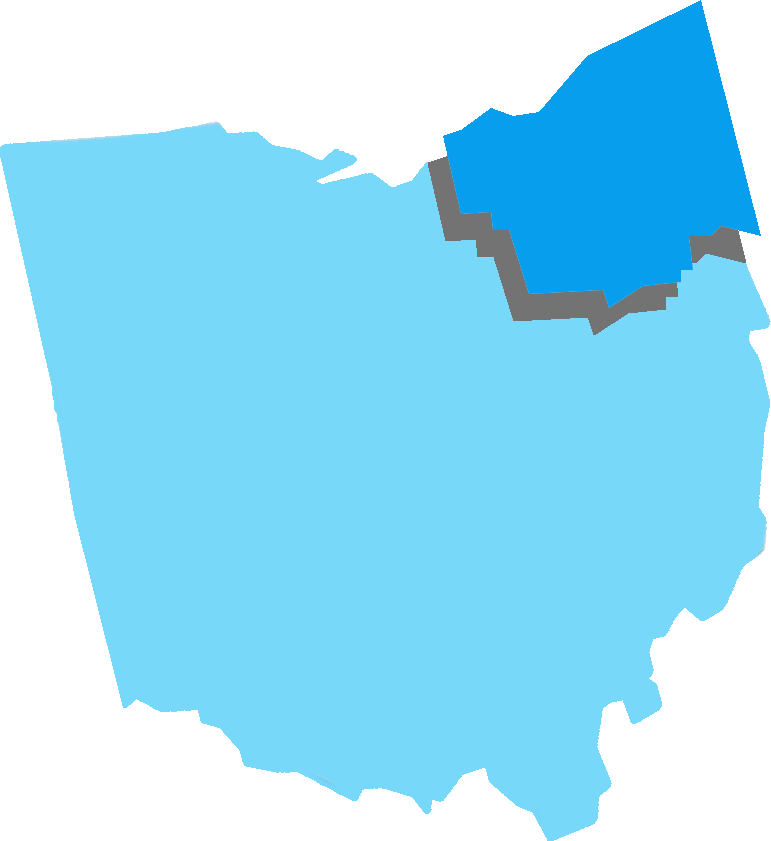

Discussion of regional cooperation in Northeast Ohio ebbs and flows, swelling during lean times and quickly receding when conditions get better — even as underlying challenges remain.
Talk grew serious about 15 years ago, during a nationwide foreclosure crisis that hit the Cleveland area particularly hard.
The Northeast Ohio Mayors and City Managers Association, with support from the Fund for Our Economic Future, pushed unsuccessfully for coordinating development and sharing taxes on new growth across 16 counties.
Four Cleveland suburbs – Orange Village, Moreland Hills, Pepper Pike and Woodmere — discussed merging but shelved the possibility of consolidation amid negative reactions from residents, concerns surrounding logistics and questions about whether savings would be enough to make the move worthwhile. Some Northeast Ohio communities pondered fire department mergers, but none gained traction.
During the same tough stretch, more than 5,000 individuals and 170 organizations spread across 12 counties helped shape a long-range vision for the region. The final document, Vibrant NEO 2040, warned that failure to collaborate could have dire economic consequences, but progress on the vision’s well-crafted priorities has been limited.
Buzz might be growing again in the post-Covid era. For example, South Euclid Mayor Georgine Welo has publicly worried that the mounting expense of redundant services will prove unsustainable for cities. She has advocated for sharing services but said that in an ideal world South Euclid and its neighbors would become distinct neighborhoods in a consolidation of Cuyahoga County’s Hillcrest area.
Concern, already serious, would escalate into panic if a petition drive for a constitutional amendment abolishing property taxes made the statewide ballot and passed. Proponents who had hoped to make it on the ballot this November came up short on signatures and say they will focus on next year.
The draconian proposal, born of property tax fatigue, would immediately strain public entities at all levels, with school districts, townships and libraries hit the hardest. Gov. Mike DeWine has warned that sales taxes might soar as high as 20 percent if voters approved the amendment.
Passage would cause disruption statewide, Ohio Municipal League Executive Director Kent Scarrett told mayors attending a Feb. 11 forum on critical federal, state and local issues, held at Cleveland State University. Cities and villages are already coping with increased infrastructure costs and an “unfunded mandate” from the state for contributions to police and fire pensions, Scarrett said.
The Vibrant NEO 2040 organization co-sponsored the forum with the Northeast Ohio Areawide Coordinating Agency, CSU’s Levin College of Public Affairs and Education and the Northeast Ohio First Suburbs Consortium. Besides fiscal threats, participants heard about modest progress on collaboration.
Efforts to achieve regional cooperation in Ohio are stifled by a fragmented political system with roots dating to the state’s founding.
The state is broken up into 88 counties, 253 cities, 673 villages and 1,308 townships. When county and regional agencies, 600-plus school districts and other political subdivisions are added to the mix, the number of taxing bodies balloons to 6,500.
This mass of local governance, held in place by the state Constitution’s principle of home rule, turns economic development into a free-for-all. Some communities win; others lose. As a result, regions suffer.
“The basic problem is our system of government,” said Thomas Bier, a retired Cleveland State University professor who has studied Northeast Ohio’s collective dysfunction for decades. “No official is elected to cooperate with anyone else. They’re elected to compete.”
Late last year, two Republican state representatives, Jack Daniels from New Franklin in the Akron area and Mike Dovilla of Berea, proposed that Ohio offer a financial incentive for government mergers.
Under House Bill 574, a two-year, $25 million pilot program would provide grants of up to $2.5 million for cities, villages or townships that agree to merge, payable when the consolidation is complete. Other political subdivisions, health districts, for example, could receive up to $1 million. Counties and school districts would not qualify. The bill remains in committee.
Daniels said the grants are primarily intended for small entities. He hopes the program can be repeated and expanded if it becomes law and draws sufficient interest.
“Ohio has the highest taxation of any red state in the country,” Daniels said. “It’s not because of the state income tax. It’s not because of the state sales tax.”
The Buckeye Institute, a think tank that advocates for free-market policy, says the layers of bureaucracy and taxation in the state discourage job growth and saddle Ohioans with one of the highest personal tax burdens in the nation when taxes are measured as a percentage of income. The think tank has repeatedly argued for consolidation of government or sharing services and resources to lighten that tax load.
In “JOINING FORCES,” a report released in 2011, Buckeye Institute research fellow Greg R. Lawson wrote that consolidation would benefit local governments if employee compensation were “managed properly.” He is confident that taxpayers would choose quality and efficiency over control.
“Frankly, Ohioans care more about the cost and effectiveness of services than they do about the name of the entity on the side of the garbage truck, police cruiser, fire truck, or school district administrative building,” reads a line in the report’s executive summary.
Lawson says the report remains relevant, along with “Beyond Boundaries,” an action plan that then-Gov. John Kasich’s administration produced in 2012.
Beyond Boundaries lays out public policy recommendations and potential collaborations local governments can adopt. Its release coincided with a sharp cut in money the state shares with local governments. The pain is still felt today.
“Ohio’s local schools and governments have reached a critical juncture,” an introductory letter for the report warns. “Service expectations continue to grow and costs are rising faster than the economy. Our school systems and government entities must find ways to reduce costs and improve efficiency. The status quo simply can’t continue.”
The February forum at Cleveland State drew about a dozen mayors, almost all of them from first-ring cities that belong to the First Suburbs Consortium. Cleveland was not represented.
Former Lakewood Mayor Michael Summers, who leads the Vibrant NEO 2040 initiative with Earl Lieken, former mayor of Shaker Heights, said that progress is being made but that communities have yet to touch three big-ticket items of police, firefighters and public works.
Challenges are” relentless and worsening,” Summers said in closing remarks. He suggested that a skilled “convenor” was needed to marshal those who are “not in the room.”
“The work is slow; it’s hard,” he said. “But it has its benefits. We need to have the determination to stay on its path.”